
It was raining, and it has been raining for weeks now, and I hope that did not deter our members from travelling. I arrived with my driver Michael who kindly picked me up. This is a thoughtful service for several of our members who might not otherwise want to drive at night. It is most appreciated. Lights were already on, tables were out, members were arriving and the general conversation was going on as usual, and had to be interrupted to get the official part of the evening started, around 7:30.
Our Chairman called us to order and gave an oversight of or goals, and why they were needed. That done the evening was passed over to our Secretary Guy who was tonight's speaker.
His talk was about the function and use of the railway track that supports the country's railway system. It started with a brief history of the gauge of the track and how standard guage was arrived at. He then went on to describe the fundamentals of the rail and why it is that shape, and went on to the chairs that hold it in place and the sleepers and the purpose of ballast. Guy spoke of how the rails were now welded together and the effect of expansion due to temperature change. If I remember correctly 1.2 metres per degree Celsius rise in temperature for 100 kilometres of track.
Guy had a little demo for us of the effect of what this meant using a length of wood held by two volunteers pushing towards each other and the bending effect, and then how retaining the centre part made this more difficult.
When setting the track in place the rails were 'pre-stretched' using hydraulic rams and how this enables the welding rather than the bolting together of track sections.
Before when the rails had joining plates and caused the very familiar ‘clickety clack’ sound this was both causing / indicating wear and the noise was wasted energy. It was interesting to find out how little contact there was with wheels and the track and when Guy went into the maximum transfer of energy for traction it was just the area of a 50 pence piece per wheel.
Surprisingly it is just as slip has started and now with modern technology using Doppler radar to monitor the phenomenon, full advantage of this can take place. (An extra from a subsequent conversation).
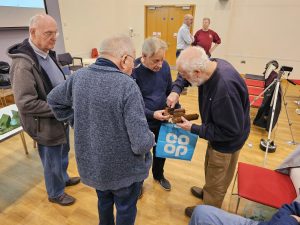
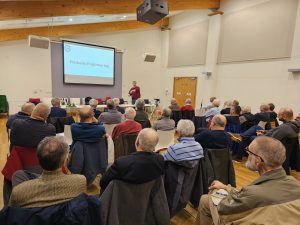
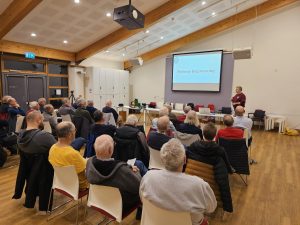
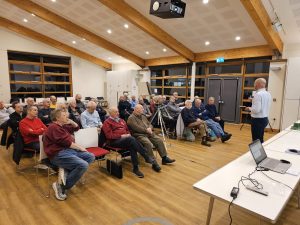
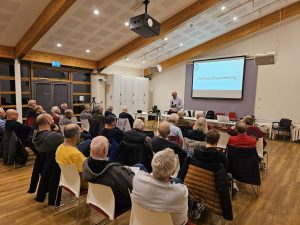
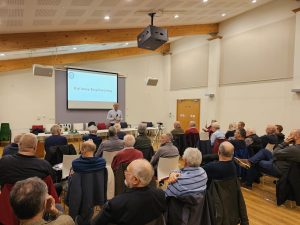
We had a break for tea from the Jack and Neil team with bikkys on the side. Nice to have break, and this was introduced when Mike Dyer became our chairman, before then it was deemed not possible. I love doing things that have been rated impossible!
We were summoned by the bell for part 2 which moved on to the maths behind maximum transfer of traction from source to track. Indicating that extra power does not necessarily lead to extra traction.
Guy finished with the many technical aspects of the level crossing. Level crossings are now rated the most dangerous part of the track system, there are around six thousand in the country and there is law in force not allowing anymore to be built.
We finished a wee bit earlier than usual but Guy had opened up a subject which was previously an unobtrusive part of the landscape until its reason and use was defined. Guy had an appreciative round of applause and then the evening was closed down by our Chairman.
Thanks to all who made the evening work and see you all next time.
Regards to all.
Roy Verden. 12th February 2026
A video of Guy's talk is available to watch on our YouTube channel: